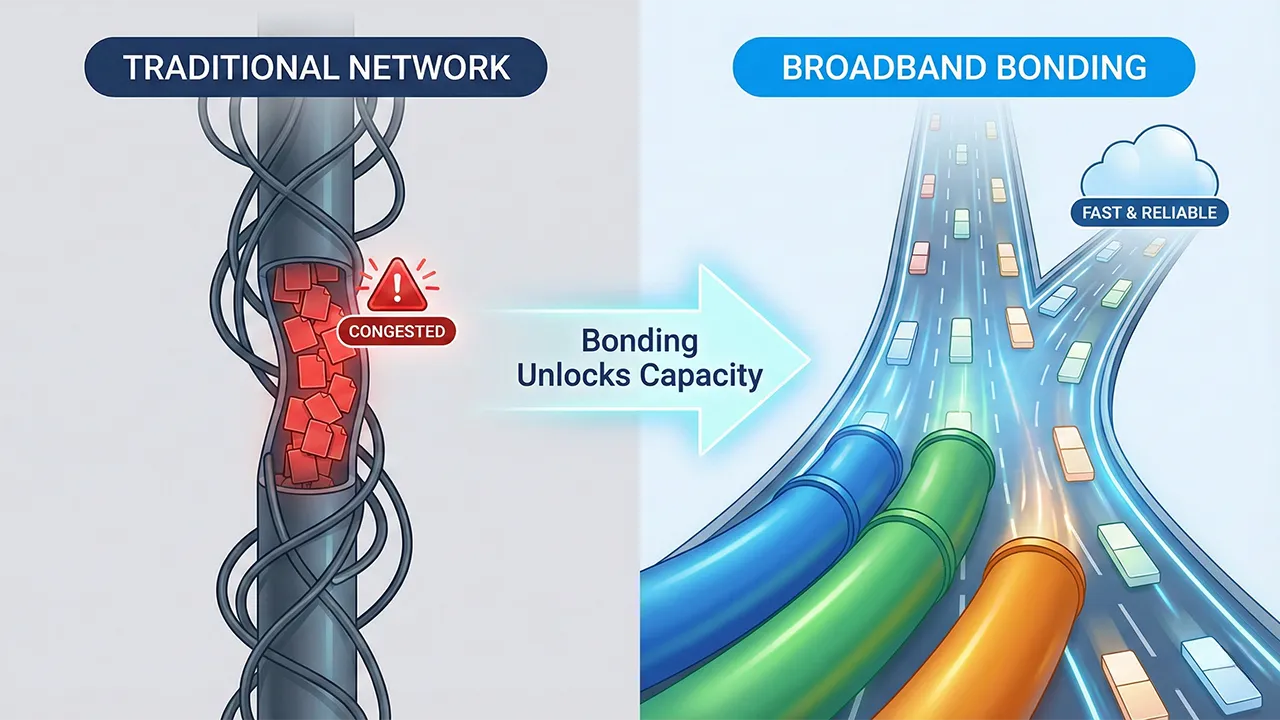
Broadband Bonding: Why It Matters Today
Broadband Bonding is becoming essential for modern organizations struggling with slow cloud applications, rising bandwidth demands and increasingly complex network environments. As companies move more of their daily operations into cloud platforms, performance issues like latency, jitter and inconsistent throughput begin to impact both productivity and user experience.
For many IT managers, the instinctive reaction is to assume that the company simply “needs more bandwidth.” But the real answer is often more strategic and significantly more cost effective. Broadband Bonding allows businesses to use what they already have more intelligently before investing in expensive new circuits.
The Real Reason Applications Slow Down
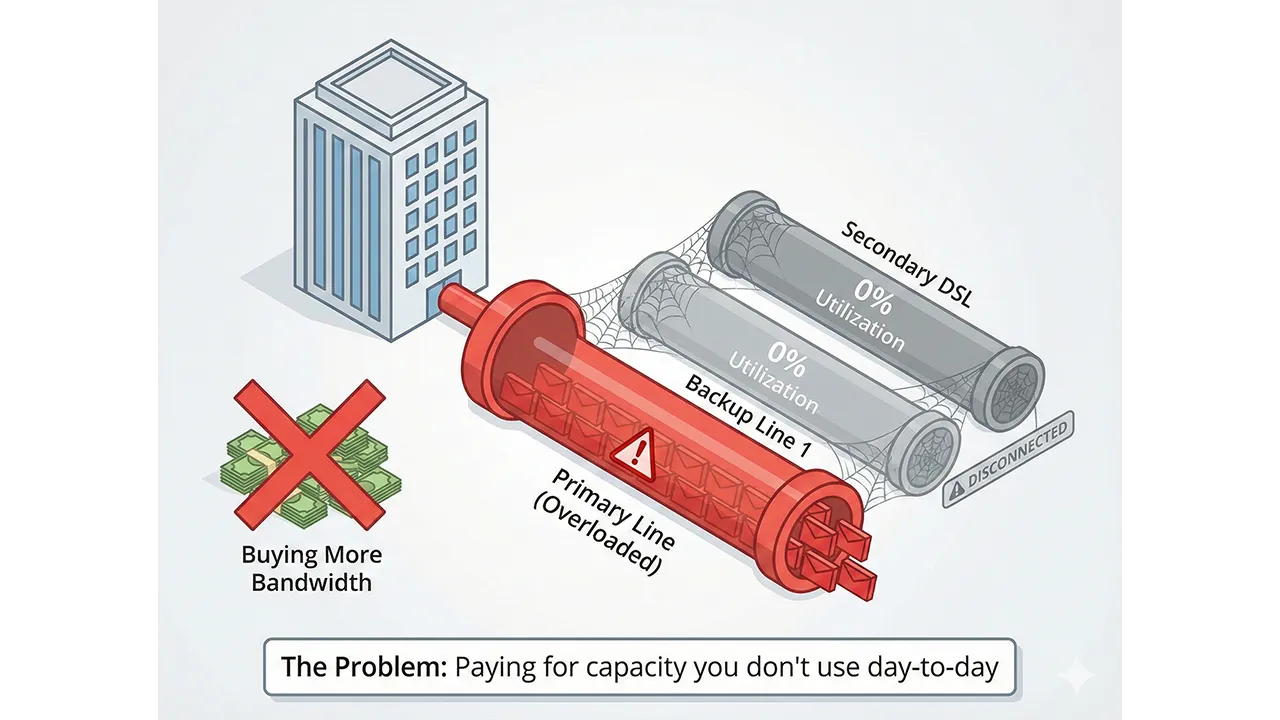
When applications begin to lag, employees experience interruptions in workflow, file delays, video meeting instability and time-consuming retries. These symptoms are commonly blamed on insufficient bandwidth, but the true cause is often uneven line utilization, idle backup links and inefficient load handling.
Why More Bandwidth Is Not Always the Right Solution
Bandwidth demand is certainly increasing. Industry research shows that organizations need far more capacity today than they did even a few years ago. The Broadband Imperative report estimates that current requirements sit near 100 Mbps per 1,000 users, and that figure will rise to approximately 1 Gbps per 1,000 users in the next two years.
While these numbers demonstrate clear growth, they do not automatically mean additional bandwidth must be purchased immediately. Most companies already possess multiple lines, backup circuits or unused resources that could be activated and fully utilized through Broadband Bonding.
Why Broadband Bonding Is More Effective Than Buying More Bandwidth
Adding additional circuits is costly, slow and often unnecessary. Broadband Bonding delivers a more efficient strategy by turning underused or disconnected lines into a single optimized pipeline.
Making Better Use of What You Already Pay For
Companies regularly invest in multiple network resources, yet many remain idle or lightly used. Traditional networking setups do not distribute traffic across all available paths, leaving enormous amounts of potential bandwidth unused.
Broadband Bonding solves this by combining these connections into one unified high-speed channel. Instead of letting backup lines sit idle until a failure occurs, Broadband Bonding uses them continuously to improve performance, stability and throughput.
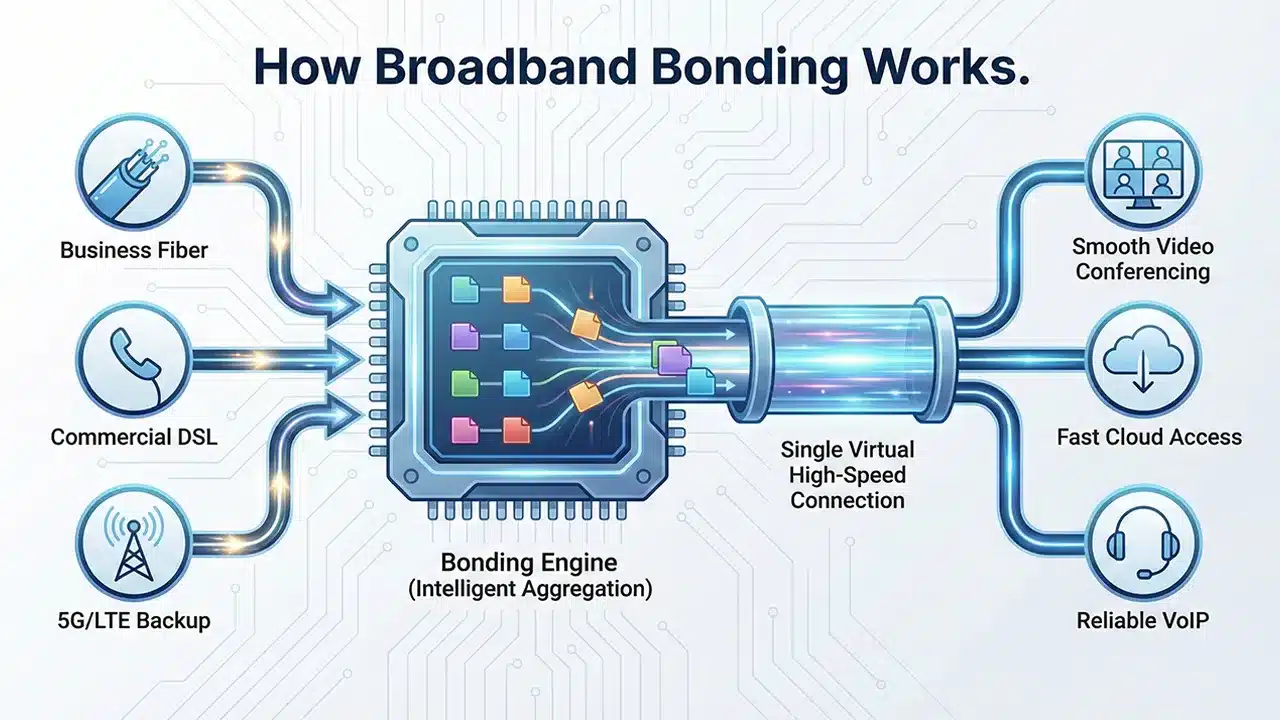
This means the business achieves better results without immediately purchasing expensive new lines.
How Broadband Bonding Uses Underutilized Resources
Most businesses underestimate how much capacity they already possess. Secondary DSL, fiber, wireless or commercial-grade links often sit untouched. Broadband Bonding activates these resources, distributing traffic intelligently across all available lines.
Optimizing Backup Links
Backup links exist for redundancy, but without Broadband Bonding, they play no role in day-to-day performance. The technology transforms them into active participants in the network, offering:
- Increased throughput
- More stable performance
- Higher availability
- Reduced congestion
Intelligent Resource Utilization
Broadband Bonding evaluates the conditions of every link in real time. Instead of routing all traffic through a single line until it becomes congested, the system distributes data based on live conditions.
This ensures smoother application performance, even during peak hours.
The Technology Behind Broadband Bonding
Broadband Bonding is effective because it uses advanced performance monitoring and adaptive optimization. comBOX applies this technology through its Virtual Leased Line architecture.
Real-Time Network Evaluation
Latency, jitter, packet loss and congestion levels are continuously measured. Instead of treating all lines as equal, Broadband Bonding uses this information to send each packet through the most suitable path.
This results in faster transfers, more stable sessions and consistent reliability.
Intelligent Packet Distribution
comBOX uses a dynamic traffic distribution algorithm that evaluates each packet’s requirements. Applications that need stable speeds, low jitter or predictable performance receive priority routing.
This strategic approach improves the performance of real-time services like:
- Video meetings
- VoIP calls
- Remote desktops
- Cloud platforms
- File transfers

Responsive Network Behavior
As link conditions change, Broadband Bonding adapts instantly. If one path becomes congested, traffic moves through another available route without interrupting user sessions.
This capability aligns directly with comBOX expertise described in bold internal references such as comBOX Virtual Leased Line, comBOX VLL Technology, and comBOX multi-WAN services.
Broadband Bonding for Businesses Without Backup Links
Companies that lack backup connections can still benefit significantly from Broadband Bonding. Publicly available, low-cost lines such as DSL or affordable wireless connections can be paired with enterprise-grade circuits.
Cost-Effective Bandwidth Expansion
Instead of purchasing a high-capacity dedicated line, organizations can combine:
- Existing enterprise leased lines
- Commercial DSL circuits
- Low-cost broadband services
- Wireless or mobile broadband
This blending approach creates additional capacity without the high costs associated with traditional upgrades.
Ideal for Growing Bandwidth Needs
As cloud services expand and teams rely on remote tools, bandwidth pressure rises rapidly. Broadband Bonding provides a scalable approach that grows easily without major infrastructure replacement.

Why comBOX Makes Broadband Bonding Enterprise-Grade
comBOX specializes in high-performance connectivity solutions for demanding business environments. Through its intelligent technology and advanced operational model, comBOX transforms Broadband Bonding into a stable, powerful and professional-grade solution.
Advanced Network Intelligence
comBOX incorporates:
- Real-time monitoring
- High-speed packet-level distribution
- Adaptive traffic management
- Instant responsiveness to network conditions
These features ensure that every available line operates at maximum efficiency.
Supporting Modern Business Applications
The system enables smooth performance for applications that power daily operations, ensuring that users experience consistent speeds and low latency.
Proven Experience Across Multiple Industries
comBOX has extensive experience across enterprise, retail, logistics, energy, hospitality and other verticals that require stable, reliable connectivity every second of the day.
FAQ
Why do applications slow down even when a company believes it has enough bandwidth?
The blog explains that slow performance is often caused by uneven line utilization, idle backup links, and inefficient load handling. Even with adequate bandwidth on paper, traffic may be forced through a single congested circuit while other available links remain unused. This results in latency, unstable video meetings, slow file transfers and interruptions in cloud applications.
Why isn’t buying more bandwidth always the right solution for performance issues?
Additional circuits are costly and slow to deploy. The blog states that most businesses already have multiple unused or lightly-used lines that can be activated through Broadband Bonding. Instead of increasing expenses, bonding turns existing resources into a unified high-throughput connection, maximizing what the organization already pays for.
How does Broadband Bonding make better use of underutilized or backup links?
Broadband Bonding actively distributes traffic across all available connections, including backup lines that normally sit idle. This increases throughput, improves stability and reduces congestion. It transforms standby resources into continuously contributing links, strengthening both performance and availability.
What makes Broadband Bonding more effective than traditional load balancing?
According to the blog, comBOX Broadband Bonding evaluates link quality in real time, including latency, jitter, packet loss, and congestion, and sends each packet through the best available path. This packet-level intelligence ensures a smoother experience for cloud applications, VoIP, video meetings and remote desktops, far outperforming basic session-based load distribution.
How does Broadband Bonding adapt to changing network conditions?
The system responds instantly when a line becomes congested or unstable. Traffic is redirected through healthier links without interrupting active sessions. This dynamic behavior ensures consistent reliability and prevents user-visible degradation, even during peak usage hours.


