
Quite often, there is significant confusion among IT managers when comparing legacy load balancers with modern Network Bonding technologies. While these solutions may appear similar on the surface, the underlying mechanics and performance outcomes differ drastically.
The ability of Network Bonding to simplify Wide Area Network (WAN) management and drastically boost network performance has already made it the dominant trend in corporate networking.
Both Network Bonding and legacy load balancing attempt to spread traffic across individual links. They both aim to route data to functional connections while isolating non-functional ones. However, the main difference—and the deciding factor for business continuity—lies in how they implement this sharing of data traffic.
Why Legacy Load Balancing Fails Modern Businesses
To understand the superiority of Network Bonding, we must first look at why conventional methods are struggling.
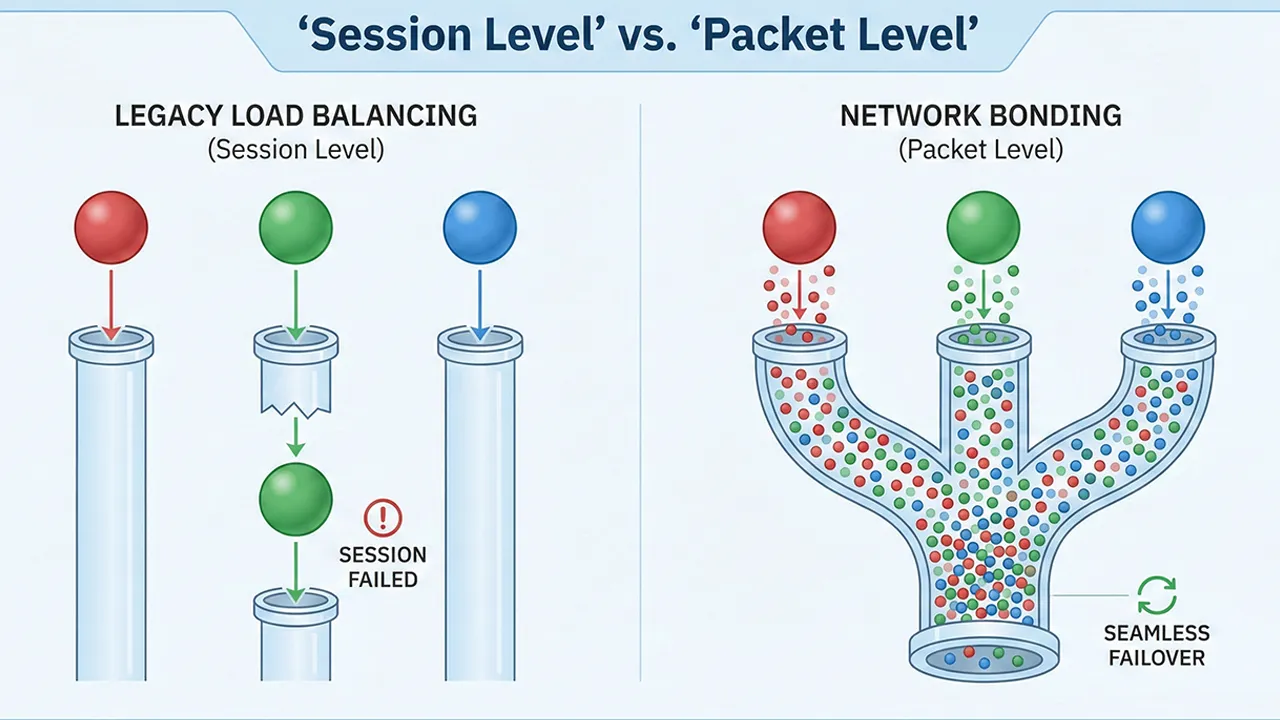
Conventional load balancers spread the load at the “session level.” This means they choose different paths or connections for routing specific TCP or UDP sessions. Effectively, each session is assigned to a single connection and is limited to the maximum speed of that specific link.
This architecture creates a single point of failure for active sessions. In case a connection fails, the session is immediately terminated. A new session must then be initiated and routed through a functional connection from the pool of remaining links.
In practice, this is disastrous for real-time applications. For example, if a local network user is on a VoIP call (e.g., a Skype or Zoom meeting) and the specific connection hosting that call fluctuates or drops, the session disconnects. The call drops.
- The User Experience: The user must call back, initiating a new session through a different link.
- The Business Impact: In a professional corporate environment, dropping client calls due to session termination is unacceptable.
How Network Bonding is Different
With comBOX technology, the paradigm shifts entirely. The network load is distributed at the “packet level” (TCP or UDP packets) rather than the session level.
This means a single session is not trapped on one wire. Instead, it is routed through all available connections simultaneously. Network Bonding effectively creates a large virtual pipe by distributing data packets across every linked connection.
This results in utilizing the total available bandwidth of all individual connections at the same time. You achieve high speeds—both uplink and downlink—even for a single file transfer or video call.
The Reliability Factor
If one of the available connections fails, the session is not interrupted. It is merely limited by the speed contribution of the lost link.
In a practical scenario, if a user on the local network has initiated a VoIP session, the data packets of this session are distributed across all available connections. If one connection fails:
The Network Bonding algorithm detects the failure instantly.
Packets scheduled for the bad link are instantly rerouted via functional connections.
The user perceives zero downtime. The telephone conversation continues seamlessly.
This seamless failover is why many enterprises are switching to our comBOX solutions to ensure 100% uptime.

Superior QoS: Prioritizing What Matters
Another aspect that must be taken seriously is the capability of prioritizing applications for business-critical operations.
Defining Quality of Service (QoS) prioritization classes in a traditional WAN load balancer is a complex, often futile process. Rules must be laid down for each individual connection. Because the total available bandwidth fluctuates based on which link is active, a single centralized policy cannot be clearly defined.
Additionally, when using DSL-type connections where performance fluctuates, QoS priority rules often fail. A load balancer cannot apply rules correctly to a connection with unstable performance.
The comBOX Advantage
Using the Network Bonding technology incorporated in comBOX services, priority rules are defined for a single, aggregated data channel.
The capacity is calculated in real-time, allowing for the reliable use of QoS classes. This ensures that your ERP, VoIP, and CRM data always get priority over non-critical web browsing, regardless of which underlying lines are fluctuating.

Conclusion: The Only Real Choice for Business
When you objectively compare the two technologies, the conclusion is clear. The only common element is the use of multiple connections to increase capacity.
However, Network Bonding technology has more features in common with high-end enterprise fiber solutions. It creates a single, robust connection with aggregated speed and rock-solid reliability that legacy load balancing simply cannot match.
If you are ready to modernize your infrastructure, explore our comBOX technology today and stop letting network failures interrupt your business.
FAQ
Why do IT managers often confuse network bonding with traditional load balancing?
Both solutions distribute traffic across multiple connections, but the blog explains that their internal mechanics differ dramatically. Load balancing spreads entire sessions across links, while network bonding distributes individual packets. This fundamental distinction determines whether businesses experience seamless uptime — or session-breaking outages.
Why does legacy load balancing fail to meet modern business requirements?
Load balancers route traffic at the session level, meaning each session is locked to a single connection. If that connection fluctuates or fails, the session terminates immediately. For real-time applications such as VoIP or video meetings, this results in call drops, interruptions, and poor user experience, an unacceptable outcome in professional environments.
How does network bonding improve reliability compared to session-based load balancing?
Network bonding distributes packets across all available connections at the same time. Because a session is not tied to one link, it remains active even if a connection drops. Packets are dynamically rerouted through healthy links with zero interruption, allowing VoIP calls, video meetings and cloud sessions to continue seamlessly.
How does network bonding maximize bandwidth efficiency?
By aggregating all available links into a single virtual pipe, network bonding unlocks the full combined speed of every connection. Even a single file transfer or video call can utilize total aggregated bandwidth. In contrast, traditional load balancing limits sessions to the speed of whichever link they were originally assigned to.
Why is QoS (Quality of Service) significantly more effective with comBOX network bonding?
Load balancers struggle with QoS because fluctuating link performance makes centralized policies unreliable. The blog explains that comBOX bonding creates one unified data channel, enabling QoS to operate on real aggregated capacity. As a result, critical traffic, ERP, CRM, VoIP, is consistently prioritized even when individual lines degrade.
What makes comBOX network bonding a superior choice for uptime-sensitive environments?
comBOX bonding algorithms detect link issues instantly, reroute packets in real-time, and maintain uninterrupted sessions. This provides 100% uptime behavior similar to high-end enterprise fiber solutions, without requiring costly dedicated circuits. Businesses gain resilience, performance, and seamless failover that load balancing cannot deliver.


