
Bonding satellite and cellular internet connections has become essential for organizations operating in remote, mobile or mission-critical environments. In the first 10 percent of this article, it’s important to clarify that bonding satellite and cellular internet connections is not just a method to increase speed; it is a transformative approach to creating resilient, flexible and high-performance WAN infrastructure.
Enterprises in logistics, maritime, oil and gas, remote operations, hospitality and public sector environments rely on a consistent network connection. Yet satellite links suffer from latency, weather sensitivity and congestion, while cellular networks vary by coverage and capacity. The answer is hybrid connectivity, powered by intelligent bonding technologies like the comBOX Virtual Leased Line platform
What Is Bonding Satellite and Cellular Internet Connections
Bonding satellite and cellular internet connections refers to combining two or more different WAN links into a single virtual high-performance connection. Instead of switching between links or relying on failover, a bonding appliance distributes packets across all available connections simultaneously. This creates a unified, fast and resilient connection that behaves like a private leased line.
Platforms like comBOX VLL technology achieve true packet-level bandwidth aggregation, end-to-end QoS, transparent same-IP failover and WAN optimization features such as TCP acceleration, real-time compression and intelligent packet distribution
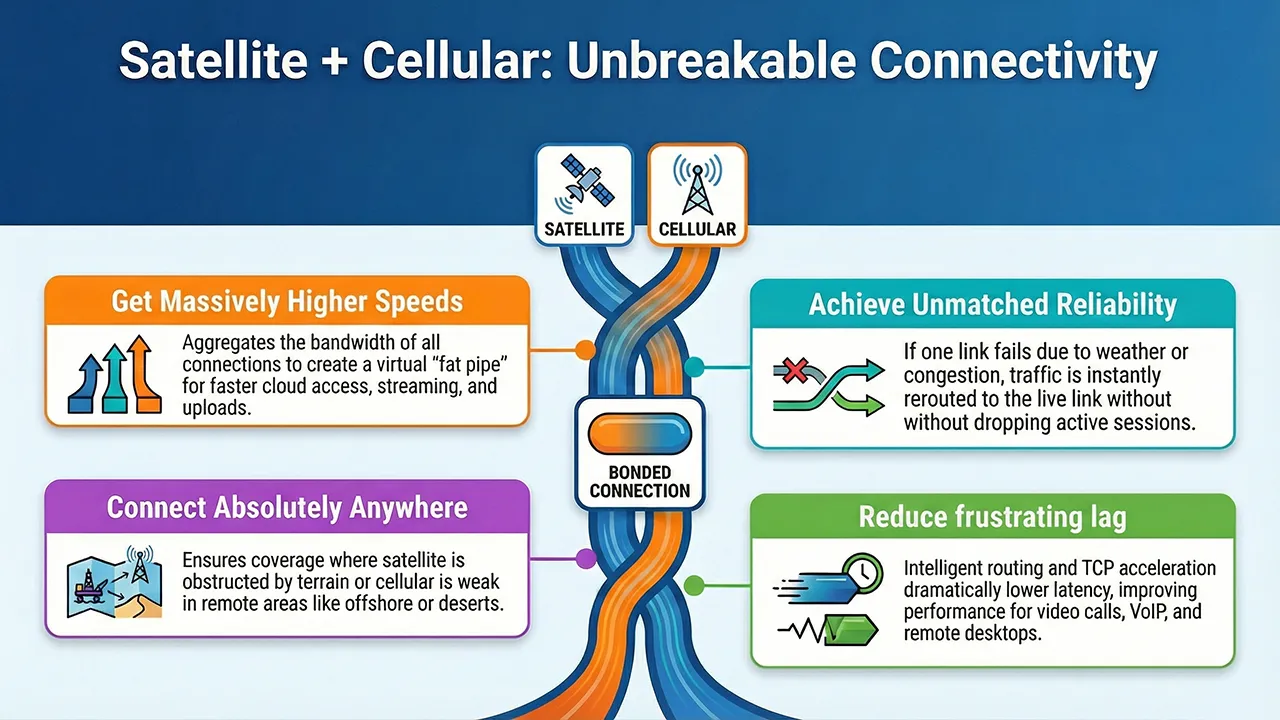
This infographic highlights how Bonding Satellite and Cellular Internet improves speed reliability coverage and performance
Why Enterprises Rely on Bonding
Organizations increasingly depend on cloud applications, VoIP, VPN tunnels, live video, remote management and mission-critical operations. Traditional single-WAN setups break easily under load or environmental factors.
Bonding satellite and cellular internet connections solves these limitations by combining the global reach of satellite with the responsiveness of cellular networks. This provides:
- Continuous uptime
- Higher bandwidth
- Reduced latency
- Improved stability
- Emergency or backup communications
- Support for real-time applications
For businesses, reliability equals revenue, productivity and operational continuity.
7 Core Benefits of Bonding Satellite and Cellular Internet Connections
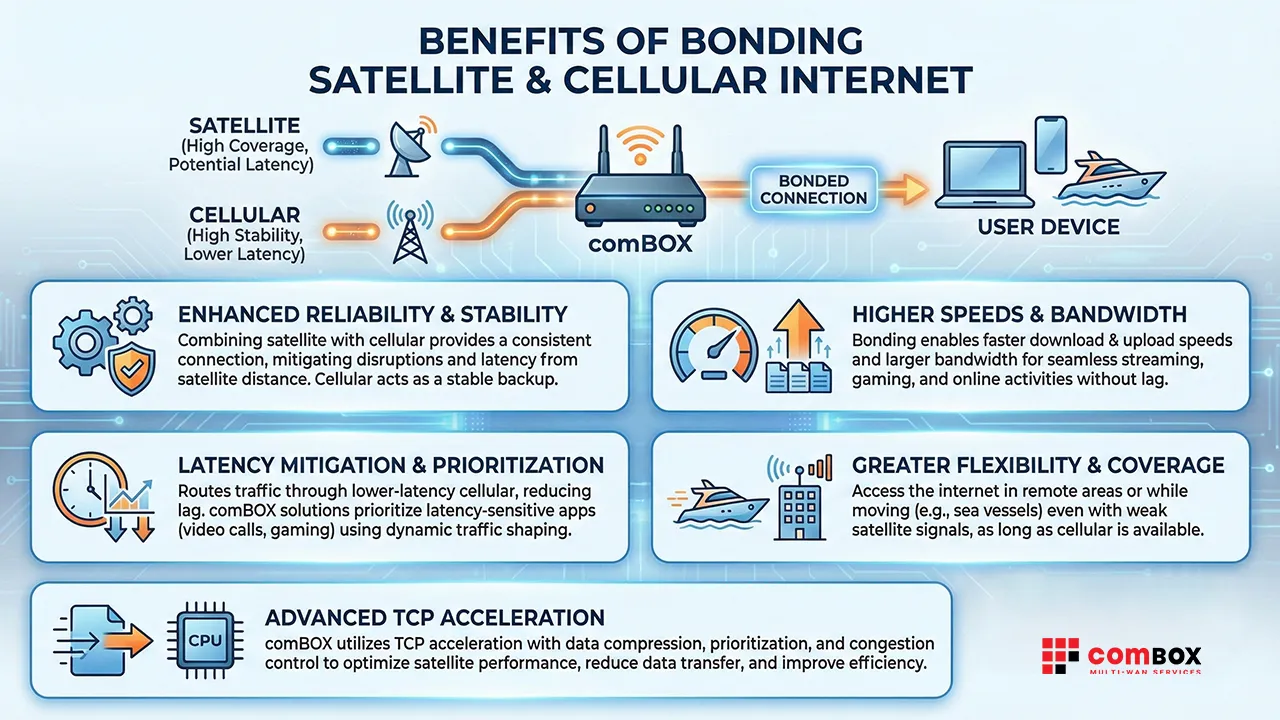
This infographic outlines the advantages of Bonding Satellite and Cellular Internet including reliability bandwidth flexibility and performance improvements
1. Higher Speed and Aggregated Bandwidth
When bonding satellite and cellular internet connections, speeds are not limited to a single link. comBOX aggregates the bandwidth of all connections to create a virtual “fat pipe” that supports:
- Multi-gigabit throughput potential
- Faster cloud access
- Improved VPN stability
- Smooth HD and 4K streaming
- High-speed uploads for surveillance and telemetry
comBOX distributes packets across all WANs and recombines them at the aggregation server
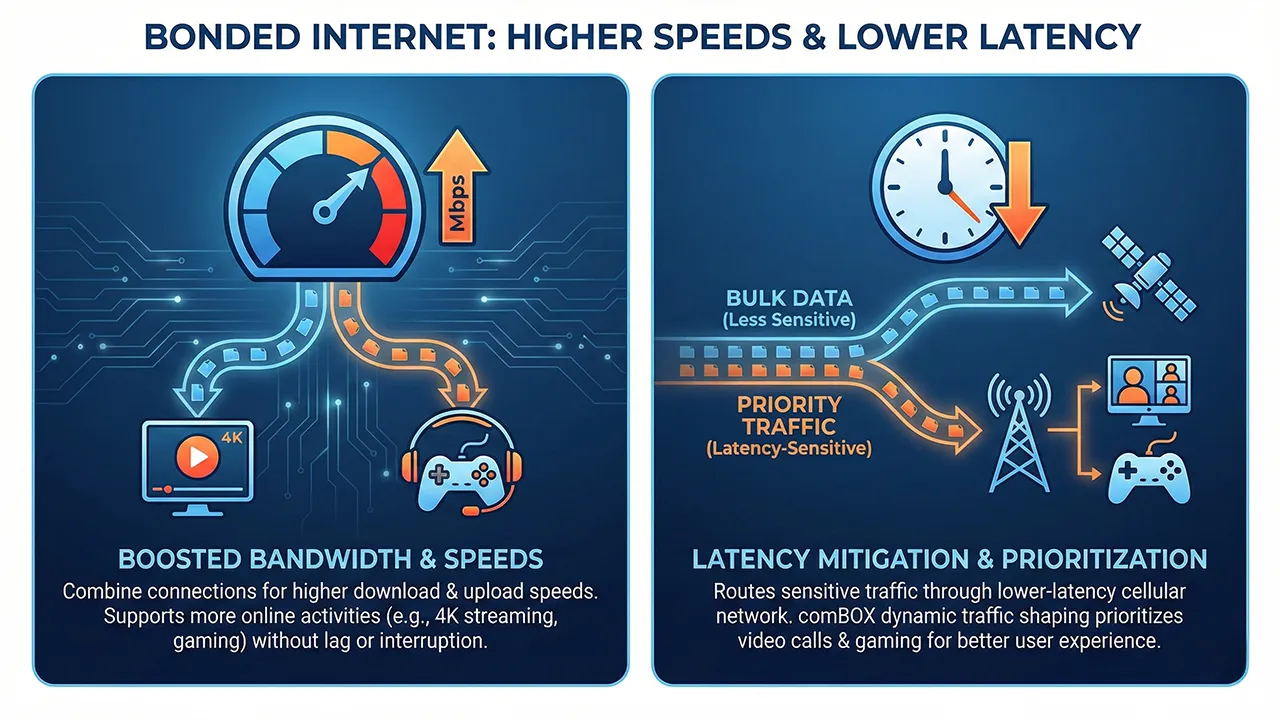
This infographic highlights how Bonding Satellite and Cellular Internet boosts speeds and improves latency management for smoother online activities
2. Unmatched Reliability with Transparent Failover
Satellite links may face outages due to weather or congestion, while cellular networks can fluctuate. comBOX’s Smart Same-IP Failover reroutes packets to the remaining live link without dropping active sessions, ensuring fully uninterrupted connectivity.
This keeps mission-critical applications stable:
- ERP and SaaS
- VoIP
- Video calls
- Remote monitoring systems
- SCADA
3. Lower Latency Through Intelligent Routing
Satellite latency typically ranges from 550ms+ (GEO) but becomes manageable when traffic is dynamically distributed. comBOX uses:
- Adaptive traffic distribution
- Low-latency routing preference
- Packet prioritization
- TCP acceleration
- Loss recovery mechanisms
This dramatically improves video calls, remote desktops and real-time cloud apps, even when satellite is part of the WAN mix.
These performance enhancements rely on comBOX’s PEP (Performance Enhancing Proxy) engine and congestion-aware algorithms.
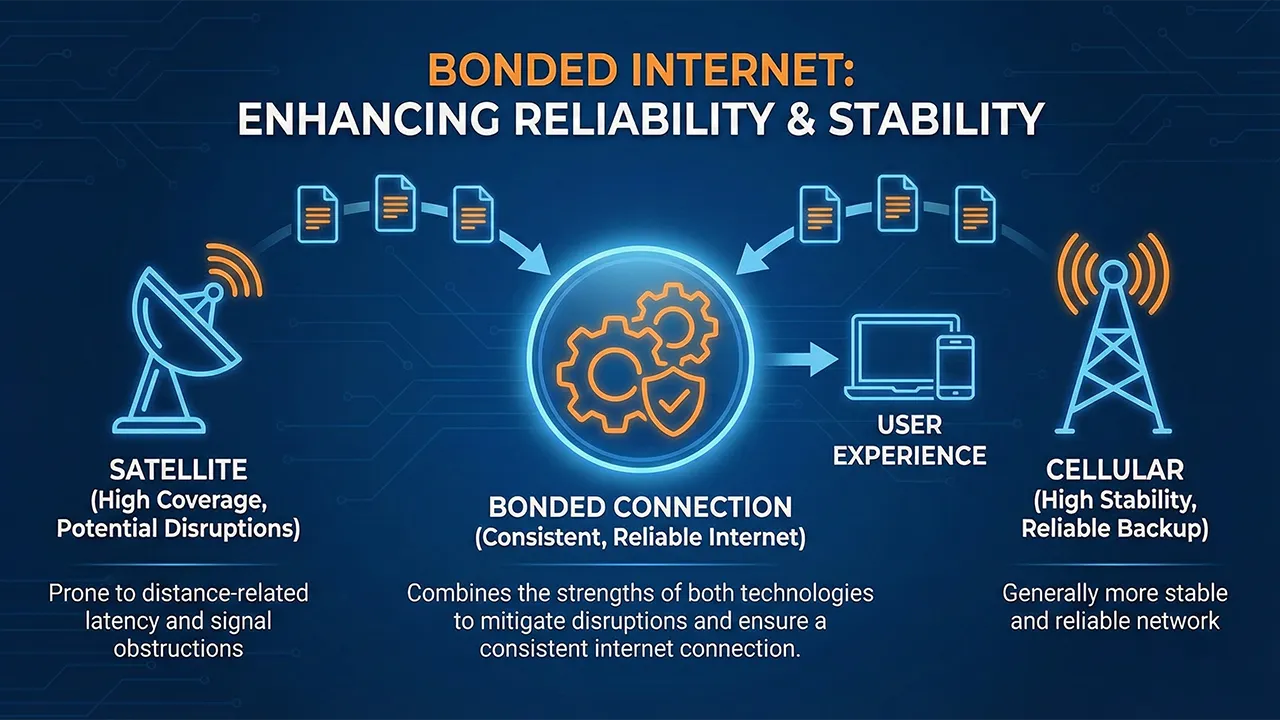
This infographic explains how Bonding Satellite and Cellular Internet work together to provide a consistent and stable connection
4. Improved Coverage in Remote and Obstructed Areas
Satellite requires open sky visibility. Cellular requires local towers. Both alone have limitations.
But bonding satellite and cellular internet connections ensures coverage even when:
- Satellite is obstructed (forests, deep valleys, tall infrastructure)
- Cellular is weak (offshore, deserts, rural areas)
Together, they create a near-ubiquitous network footprint ideal for maritime vessels, offshore rigs, construction sites and emergency response units.
5. Enhanced Application Quality with End-to-End QoS
comBOX offers advanced bi-directional QoS, ensuring that critical traffic receives priority even during network congestion. This is ideal for:
- VoIP
- Video conferencing
- Telemetry
- Streaming feeds
- SCADA and industrial control
QoS settings ensure that background downloads or non-critical services never interrupt real-time applications.
6. Cost Optimization and Better Utilization of Existing Resources
Enterprises often overpay for premium satellite or leased-line services. Bonding allows them to use:
- Affordable consumer or business satellite plans
- Multiple 5G/4G SIMs
- Low-cost fixed links where available
This hybrid mix reduces cost while increasing performance.
comBOX’s real-time compression, jumbo frames and intelligent routing reduce the amount of data transmitted over expensive satellite links, further lowering operating costs.
7. Enterprise-Grade Security and Stability
Bonding satellite and cellular internet connections with comBOX also enhances security by:
- Distributing packets across multiple WAN paths
- Using TLS 1.2 encryption between CPE and aggregation servers
- Providing node-level authentication
- Supporting VPN encryption (SSL/TLS, RSA 4096)
Packet-level distribution itself acts as a security layer since captured traffic from one WAN does not reveal the entire data stream.
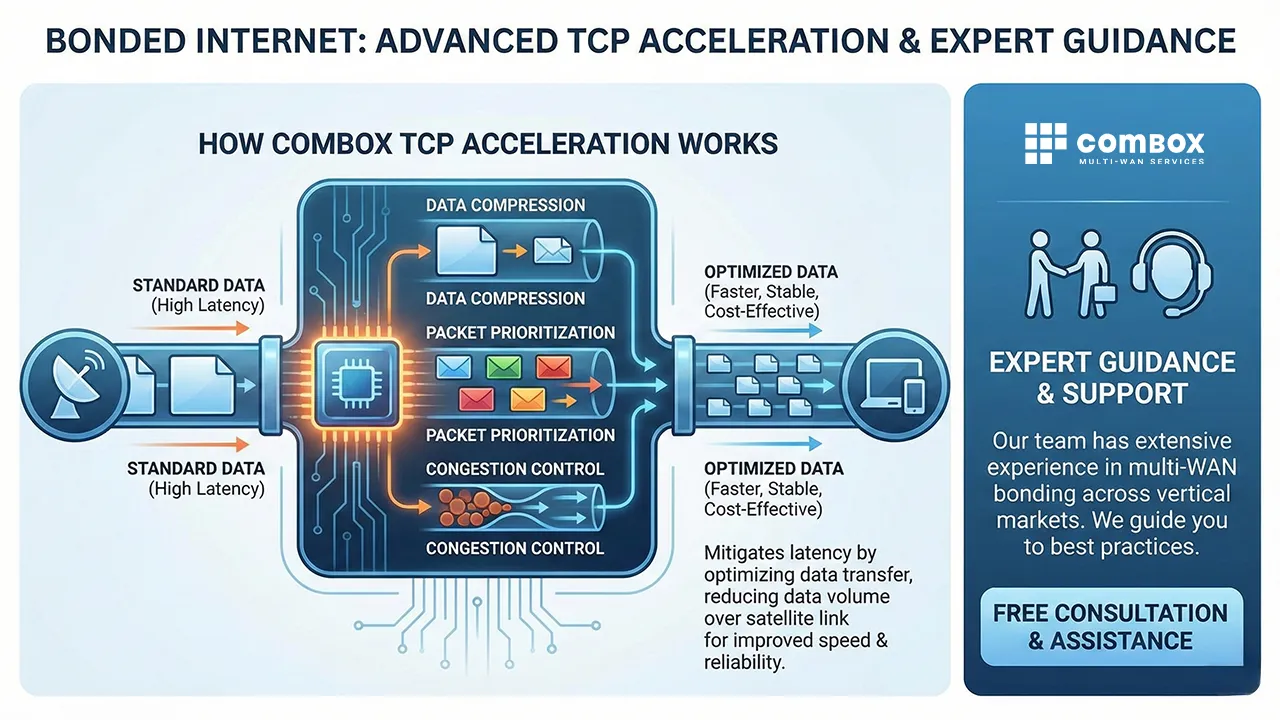
This infographic explains how Bonding Satellite and Cellular Internet benefits from advanced TCP acceleration to improve speed stability and efficiency
How comBOX Enhances Hybrid Internet Access
comBOX offers one of the most advanced multi-WAN bonding solutions available globally, with proprietary technologies proven in enterprise deployments across maritime, banking, logistics and telecom environments.
Key capabilities include:
- True packet-level aggregation
- TCP acceleration for satellite
- Transparent same-IP failover
- Forward error correction
- Real-time compression
- Intelligent adaptive routing
- Centralized management platform
- Hardware failover clustering
- Support for any WAN type including Starlink, VSAT, 5G, ADSL/VDSL, Fiber and Microwave
Internal Links:
All features derive directly from comBOX’s VLL platform architecture
Best Use Cases Across Industries
Maritime
Stable connectivity across oceans for navigation, crew welfare, CCTV uploads and real-time vessel tracking.
Oil and Gas
Reliable connectivity in deserts, offshore rigs and mountainous extraction areas.
Logistics
Real-time tracking and command operations for fleets and mobile units.
Hospitality
Hotels use bonding to ensure uninterrupted guest internet and property management systems.
Remote Enterprises
Construction, mining and research facilities depend on stable hybrid access.
Bonding satellite and cellular internet connections gives businesses a robust, flexible and high-performance WAN architecture that ensures uptime, boosts productivity and reduces costs. With comBOX VLL technology, organizations gain carrier-grade features, unmatched reliability and a unified internet experience that works anywhere on the planet.
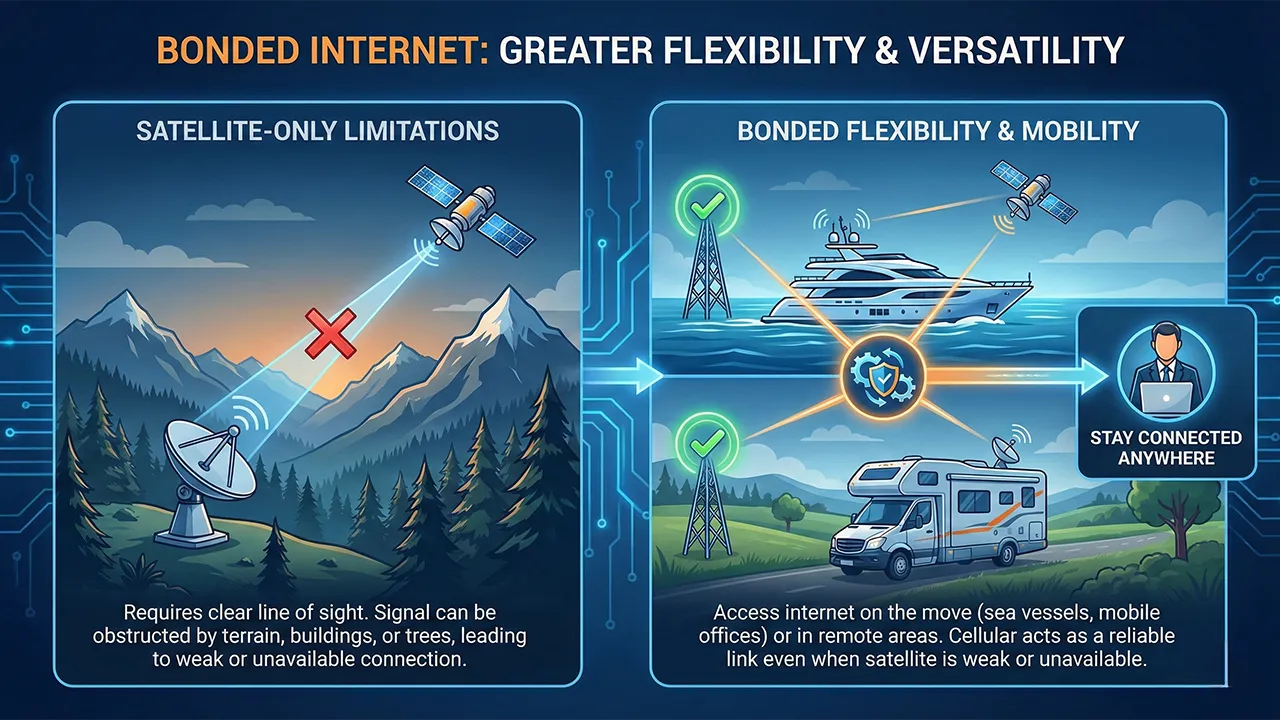
This infographic illustrates how Bonding Satellite and Cellular Internet overcomes terrain and line of sight issues to maintain stronger connectivity
For professional deployment guidance, book a free consultation
FAQ
Why do businesses often combine satellite and cellular connections instead of relying on just one?
Because each medium has limitations, satellite offers availability in remote areas but suffers from high latency and weather-related instability, while cellular provides low-latency performance but fluctuates based on coverage and network congestion. By bonding both, organizations gain higher and more stable throughput, consistent uptime, and a more reliable user experience.
What practical benefits does bonded satellite + cellular connectivity deliver?
It provides smoother video calls, more stable cloud application performance, consistent VPN connectivity, and better reliability during peak cellular load or adverse weather. The bonded link masks the weaknesses of each individual connection, resulting in an aggregated, more resilient Internet service.
How does bonding improve performance if satellite links have high latency?
The bonding system distributes traffic across both links simultaneously. Low-latency cellular paths handle time-sensitive traffic, while the satellite’s available bandwidth contributes additional throughput. The result is improved responsiveness and higher aggregate speeds compared to using satellite alone.
How does bonding help during cellular congestion or weather-affected satellite outages?
When one link degrades (e.g., cellular congestion or satellite rain fade), the bonding system shifts traffic toward the healthier link, maintaining continuity. This reduces downtime and prevents application disruptions, delivering a more predictable user experience.
Can bonded satellite + cellular replace expensive single-provider enterprise Internet solutions?
Yes. The blog highlights that businesses can achieve reliable, high-performance connectivity by combining affordable connections rather than depending on costly dedicated circuits. The bonded setup often provides similar or better stability at a fraction of the cost.


