
Are you tired of the exorbitant costs associated with maintaining your corporate network? If you are searching for a reliable MPLS alternative, you are not alone. Until recently, enterprises were held hostage by the need for guaranteed connectivity.
The only way to ensure anticipated performance between corporate branches was to purchase expensive leased lines or services like MPLS VPN. For decades, MPLS has been the flagship of enterprise WAN services, earning its status as the link option of choice due to reliability and Quality of Service (QoS) controls. However, the landscape has changed.
New MPLS alternative technologies are disrupting the market, proving that you no longer need to pay a premium for stability.
The High Cost of Traditional MPLS
Multiprotocol Label Switching (MPLS) VPNs continue to show growth across various vertical markets. It is often positioned as the optimal link solution for enterprises adopting mobility and cloud computing. However, it has a major drawback: extremely high cost.
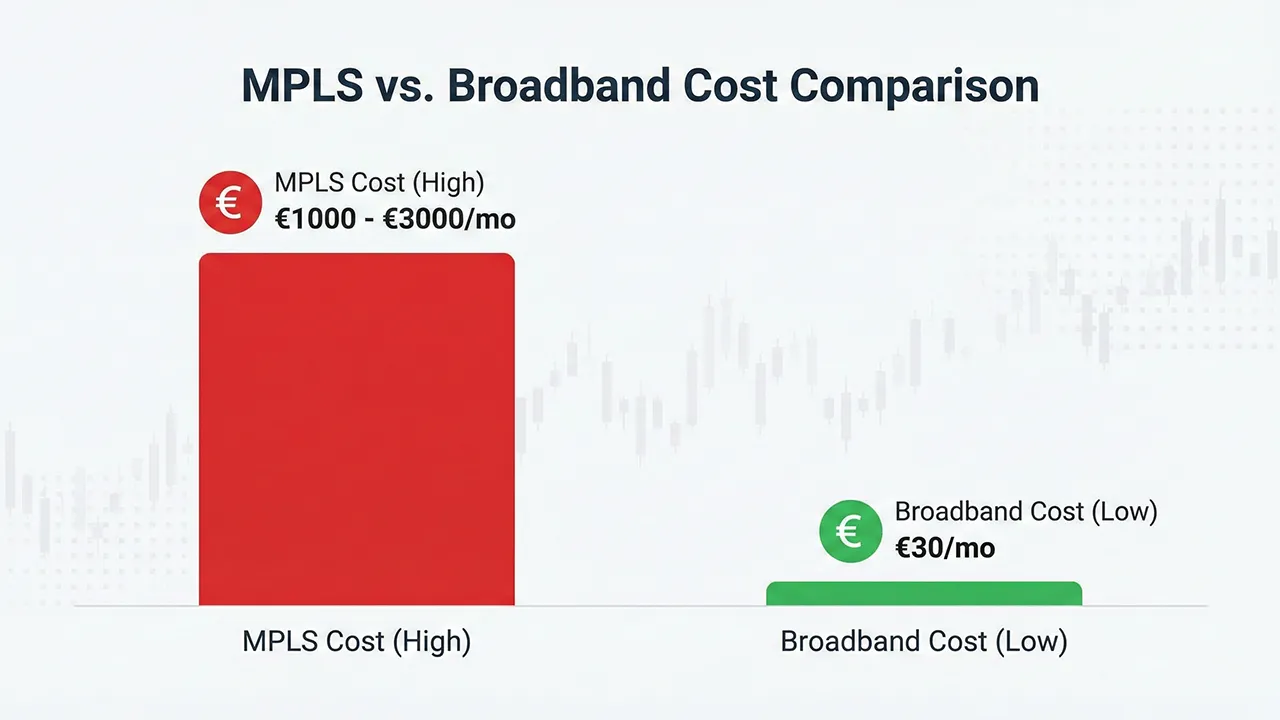
In markets like Greece, the price for MPLS ranges from €1,000 to €2,000 per month for a mere 2 Mbps of bandwidth. International locations pay even more, often exceeding €3,000 per month for the same slow 2 Mbps connection.
In stark contrast, consumers can buy high-speed connections, such as VDSL or Fiber, reaching 50 to 100 Mbps for as little as €30 per month. This massive price disparity is driving the hunt for a viable MPLS alternative.
Can We Reduce WAN Costs?
The question emerges: can this cost be reduced? Can an MPLS alternative truly compete on availability and performance?
For medium-sized companies transferring corporate data to the cloud, network failure is not an option. The short answer for traditional providers is “no.” This is due to the conditions governing the global telecommunications environment.
Companies providing private MPLS networks commit to 100% availability of their core network. They must enforce rigorous quality demands on local access partners. When MPLS is deployed internationally, it involves many partners. The aggregated result requires expensive guarantees, passing a high cost to the end client.
Enter WAN Virtualization: The Superior MPLS Alternative
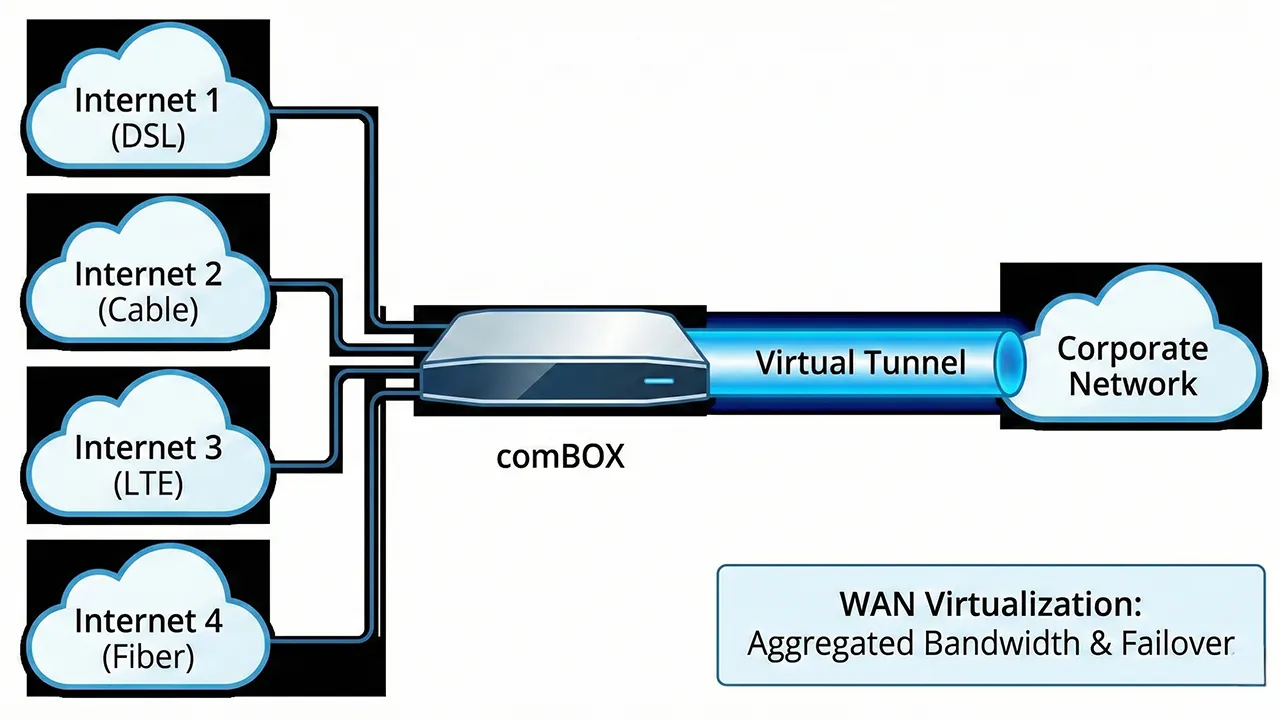
The emergence of WAN virtualization technology, such as comBOX services, means that commercial connections can finally give MPLS a run for its money.
comBOX services act as a robust MPLS alternative by solving the Internet’s inherent problems. We address network peering points that become bottlenecks where congestion and packet loss occur. We also eliminate single points of failure.
How is this accomplished? By utilizing two or more Internet connections at each location. comBOX monitors the performance of each path between remote sites and the corporate backbone with extreme precision.
How comBOX Optimizes Traffic
To function as a true MPLS alternative, the technology must be intelligent. comBOX services analyze packet loss, jitter, latency, and congestion in real-time.
The system makes real-time traffic engineering decisions, also known as adaptive self-tuning. It distributes packets of information across available routes based on current traffic conditions. This effectively addresses the transient instabilities of individual connections.
By providing physical diversity in the first and last mile, comBOX detects and avoids congested peering points. This allows WAN virtualization to move traffic from one path to another instantly without disrupting active sessions.
This process is an order of magnitude faster than standard routing protocols. Unlike a backup MPLS connection or IPSec VPN, which often drops the session during failover, comBOX keeps your applications running smoothly.
5 Benefits of Switching to an MPLS Alternative
Why should you consider making the switch today? Here is why WAN virtualization via comBOX is superior:
- Unbreakable Sessions: Application sessions don’t break, and VoIP calls don’t drop.
- Predictable Performance: Users experience consistent speed regardless of individual line fluctuations.
- Peace of Mind: IT staff sleeps soundly because network failover works transparently.
- Massive Bandwidth: Internet connections are faster than MPLS circuits, giving you more speed for less money.
- Flexibility: You can easily add more circuits or leverage new access technologies (like 5G) as they become available.
Integrating with Legacy Networks
If you are reading this after recently signing a three-year contract, don’t despair. You can still leverage a modern MPLS alternative.
WAN virtualization is a Layer 3 technology. It can be used to augment existing MPLS networks by “lighting up” your back-up circuits and making your connections active-active. This hybrid approach improves performance immediately.
Eventually, you can cap, reduce, or eliminate legacy circuits at your sites, fully transitioning to a cost-effective MPLS alternative.
The era of expensive, rigid leased lines is ending. By adopting a modern MPLS alternative like comBOX, you gain speed, reliability, and significant cost savings.
FAQ
Why are enterprises searching for an MPLS alternative today?
MPLS has historically been the gold standard for reliability and predictable performance between branch locations. However, the blog explains that MPLS costs have become excessively high — especially internationally — while consumer-grade connections now offer far higher speeds at a fraction of the price. This cost imbalance is driving organizations to seek more flexible, affordable WAN technologies.
Why is traditional MPLS so expensive compared to commercial broadband?
MPLS providers must guarantee 100% availability of their core networks and enforce strict quality standards on all local access partners. These guarantees require multiple international intermediaries, each adding cost. As the blog notes, a 2 Mbps MPLS link can cost €1,000–€3,000 per month, while a 50–100 Mbps commercial broadband connection costs roughly €30 per month.
Can WAN costs be reduced without sacrificing reliability?
Yes. The blog explains that WAN virtualization provides a viable alternative by leveraging multiple inexpensive Internet connections and applying intelligent traffic engineering. This approach offers reliability and performance comparable to MPLS — without the associated premium costs or vendor lock-in.
How does comBOX use WAN virtualization to function as an MPLS alternative?
comBOX combines two or more Internet connections at each site and continuously monitors performance metrics such as packet loss, latency, jitter and congestion. Its real-time traffic engineering ensures packets take the best available route, bypassing unstable ISP paths and eliminating single points of failure. This creates a stable, high-performance virtual link between locations.
What makes comBOX failover and traffic stability superior to MPLS or IPSec VPN?
Standard failover mechanisms typically drop sessions, causing interruptions to calls, applications and VPN tunnels. According to the blog, comBOX performs instantaneous path switching without breaking active sessions. This ensures smooth VoIP calls, uninterrupted cloud access and stable connectivity even during ISP outages or peering problems.
What are the top business benefits of adopting an MPLS alternative like comBOX?
The blog highlights five major advantages:
• Unbreakable sessions – No dropped VoIP calls or broken application connections.
• Predictable performance – Consistent speeds even when individual links fluctuate.
• Peace of mind – Transparent failover ensures operational continuity.
• Higher bandwidth at lower cost – Commercial connections offer far more speed than MPLS.
• Future flexibility – Easily add circuits or adopt new technologies such as 5G.
Can comBOX be integrated with an existing MPLS network?
Yes. WAN virtualization operates at Layer 3 and can augment current MPLS deployments by activating backup circuits in an active-active configuration. This improves performance immediately. Over time, businesses can scale down — or fully replace — legacy MPLS circuits as they transition to more cost-effective virtualized WAN architectures.


